
The War - Part 2
Beginning of the End

“Seems you didn’t take me seriously,” Mr. Brown said, pacing in front of the classroom. “Starting today, you will no longer have access to the rest of the school during recess. This entire class is restricted to the basketball courts.”
Mr. Brown stopped and looked into all of our faces, as if to finalize the statement, imprint it into our minds.
When Mr. Brown left the classroom, he left behind an enormous emptiness that Mrs. Nichols struggled to fill, searching for words. Her face showed the pain she felt, but not out of wounded pride, as if our actions had caused her to lose face. It was something closer to what a mother might feel toward her own children when their actions had caused them harm.
“Not since I’ve been at this school has this ever happened to another class,” Mrs. Nichols said, shaking her head, pressing her hands together. “Are you all satisfied now?”
During recess, we watched the rest of the school run the track, swing, slide, and roam freely across the playground.
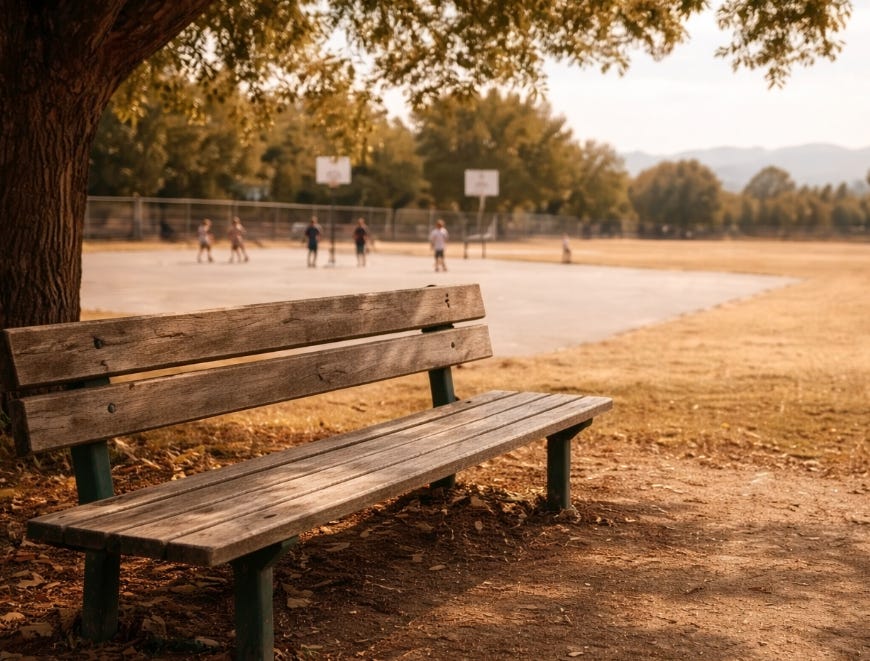
There was a weathered bench tucked away in a corner on the far side of the courts. It sat beneath an old elm tree, and we claimed it as our own. From there, we watched the seventh and eighth graders play basketball, hoping one of us might be picked. None of us ever were.
We kept to that bench during recess, far from the girls and our commandeered basketball court, which, strangely enough, was abandoned almost as soon as we started spending time there. Then one day, all the girls came at once—one mass, one voice.
“Why don’t you guys play basketball anymore?” Leslie said. She had become the de facto leader of the girls.
John stepped forward, arms crossed over his chest.
“What do you want?”
In mock admiration, Leslie crossed her arms too.
“We’d like to use the bench sometimes.”
“Not a chance. This is our bench,” John said.
“No, it’s not. It’s the school’s bench, and it’s not fair that you get to have it and we don’t.”
“We were here first. First come, first serve.”
“How about we take turns?” Leslie dropped her hands to her sides and cocked her head.
“You get it today. We get it tomorrow.”
“Not a chance,” John said. “This is our bench.”
“We’ll see.”
The next day, while we were throwing away our trash and getting ready to head over to the bench, all the girls sprinted across the blacktop toward it.
“Manny! Manny! They’re getting our bench! Catch ’em! Catch ’em!”
Manny tore across the blacktop after them, still chewing his food, but he couldn’t overtake them.
It should’ve been fine. We had both courts to ourselves, enough for a full-court game, but it was the principle of the matter. There was a sense that the girls had won. It was more than just winning the right to sit on the bench that day, and more than we could take.
Whatever we did, we did on impulse, reacting in the moment, striking out when we felt struck. What they did was planned. Calculated. From that moment on, the stakes were raised in a game where the rules were always changing.
The girls never got the bench again. Before the bell released us for lunch recess, we lined up, all of us, boys and girls, side by side. When the bell rang, it was as if a force of nature had torn through the school. Manny was our Hermes, our Mercury, our chosen one. He left everyone in a distant second.
Each day, when Manny reached the bench, we cheered, not only for victory over our perceived enemy, the hated, the confusing, the lovely girls, but for something deeper, a sense of unfairness we felt building against us.
This went on for some time until one day a brand-new bench appeared on the opposite end of the basketball courts. Even though we had claimed rights to our bench, the sudden appearance of this new one felt like an affront to our dignity, like we’d been slighted somehow, especially as the girls waved and smiled at us during recess.
I came to school early one day and saw Mr. Najera, the groundskeeper, turn the girls’ bench over after someone had flipped it. Whenever I arrived early, I’d see this play out like some kind of morning ritual.
No one knew who was doing it. That changed the day I went riding bikes with John Zimmerman. We rode until sunset, zipping through town, getting ice cream, hollering and laughing as we sped through the alleys.
“Come on. Let’s go this way.”
“I’ve got to get home, John.”
“It won’t take long. Come on.”
We rode to St. Mary’s, cutting through the headlights of passing cars. We parked our bikes, and I followed John over the back fence, running to catch up with him.
“Come on, slowpoke.”
I already knew what he was going to do. John grabbed one side of the bench and flipped it over. It crashed hard against the ground. Chips of wood splintered and flew in all directions. Then John pulled himself out and pissed all over it in one long, continuous stream.
“Look ma!” he laughed. “I’m on top of the world!”
This all came to its inevitable conclusion when Mrs. Nichols decided to rearrange the desks. Maybe she thought a new arrangement of neighbors would lead to some kind of solution and finally end this ceaseless feud between us.
I was hoping I’d get to sit behind Jenny, but it was not to be. When the shuffling of desks ended, it was Arnold Beltran who had that honor.
I suppose most major conflicts in history begin as trifles. A gesture. A word. Perhaps even something as small as a sneeze at the wrong moment, ending in an explosion or a battle cry. And I suppose they end much the same way. The beginning of the end of our war with the girls came with a simple flip of hair.
That day, Jenny’s mom had curled her hair so that it rested on her head like little golden rosettes, bouncing as she walked. I was mesmerized.
The first flip of her hair landed on Arnold’s math work. He froze. Then he straightened, brushed it aside, and continued. A moment later, she flipped it again. It fell across his desk.
“Can you not do that?”
“Do what?”
Jenny giggled. Toby, sitting next to her, laughed too as she glanced back. Arnold brushed the hair away again and kept working. It happened a few more times, until finally Arnold stood and walked to the back of the classroom.
Arnold was mild-mannered, the class nerd, and because he was the smartest, that kept him safe from the rest of us. You never knew when you might need help with your math homework. Still, there was always something a little strange about him. We thought it was just his nerdiness, but that day proved it was something else.
When Arnold returned to his seat, he was holding a pair of crafting scissors. It seemed no one else noticed. Had they, I’m sure they would have done something. It was like watching it in slow motion as Arnold, very carefully, very deliberately, took hold of Jenny’s hair and brought the scissors to it.
“Arnold!” screamed Mrs. Jaussand.
But it was too late. I remember a long lock of falling hair, those golden rosettes dropping softly to the floor.